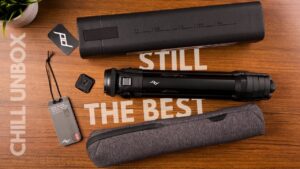
The Synco Mic-D2 landed on my desk, and in the video above you can watch me open the box and run it through a first test. Fair warning: this is an unboxing and first impressions, not a six-month field report. I'd rather tell you that up front than pretend otherwise.
My questions for any microphone are boring and practical. Does it feel like a tool? Does the sound hold up without a fight in post? Clients forgive a soft shot. They do not forgive audio they can't hear.
Here's what stood out as I went through it - the case, the brass body, the hypercardioid pickup pattern, and the bass boost enhancer.
The case makes a good first impression
The Mic-D2 ships in a rugged case, and I want to give that more credit than unboxing videos usually do. Microphones live a hard life. They ride in backpacks, slide around in trunks, and get packed in a hurry at the end of a long day. A real case means the mic survives all of that without me having to think about it.
Plenty of gear that costs real money ships in what is essentially a sock. So when a company spends money on protection instead of prettier cardboard, I notice.
A brass body is an unusual choice
Most microphone bodies you'll handle are aluminum or plastic. Synco went with brass for the Mic-D2, and you feel it the second you pick it up. Brass is a dense metal, so the mic has real heft to it - it feels solid in the hand rather than hollow.
There's a trade-off, and I'll name it: weight. If you're flying a stripped-down gimbal setup where every gram is a negotiation, a brass mic is a decision, not a default. On a cage, a boom, or a tripod rig, it's a non-issue - and the durability argument starts to make a lot of sense.
Hypercardioid, in plain English
The Mic-D2 uses a hypercardioid polar pattern. Skip the textbook diagram - what it means in practice is that the mic hears mostly what it's pointed at and rejects a good chunk of what's beside and behind it. That's the whole job of a directional mic: more subject, less room. A pattern like this earns its keep in situations like:
- Sit-down interviews where the mic hangs just out of frame
- Run-and-gun dialogue where you can keep it aimed at the speaker
- Untreated rooms, where rejecting reflections beats any plugin you'll buy later
- Locations with noise off to the sides that you'd rather not record
The catch with any tight pattern is that aim matters. Point it sloppy and you'll hear it. That's not a flaw, it's physics - but it's worth knowing before you buy.
The bass boost enhancer, and the actual test
The other feature Synco highlights is a bass boost enhancer. The idea behind a control like this is simple: lift the low end to put some weight back into a voice, which can help when a speaker sounds thin or the mic is working at a distance. Having that on the mic itself, instead of as a fix in post, is the kind of practical touch I appreciate.
As for how it actually sounds - I'm not going to write you a paragraph of wine-tasting adjectives. "Warm." "Airy." "Buttery." That's marketing, not information. I run the mic through a test in the video above, and thirty seconds of listening with headphones will tell you more than anything I can type here.
What I personally listen for is a clean, usable signal - something I can drop into the edit and shape without surgery. Watch the test and judge it against your own standard, because your room and your voice aren't mine.
Who the Synco Mic-D2 is for
Based on this first look: the Mic-D2 makes sense for solo shooters and creators who want a directional mic that feels like it was built to last, and who like the idea of a bass control on the mic instead of another fix in the edit. The rugged case and the brass build suggest Synco expects this thing to get used, not displayed on a shelf.
Who should think twice? Anyone counting grams on a small rig, for the reasons above. And anyone who needs a long-term reliability verdict today - I can't give you one yet, because this is day one with the mic. If it earns a permanent spot in my bag, you'll hear about it.
My honest bottom line: the unboxing impressed me more than unboxings usually do, and the feature set is sensible rather than gimmicky. The sound test in the video above is the real review - go listen to it.
And if you want to see what's actually earning its keep in my kit right now, that list lives on my gear page.